Is AI the Second Dot-Com Bubble?
I spent some time reading about the dot-com bubble and the current AI boom because I keep hearing the same question:
Is AI just dot-com bubble 2.0?
Should we avoid it?
How do we live with it without getting fooled?
My short answer is:
Some parts of AI look like a bubble.
The technology itself is not fake.
The right move is not to avoid AI.
The right move is to avoid AI theater.
That is the line I would keep in my head.
What the dot-com bubble teaches
The dot-com bubble is easy to misunderstand.
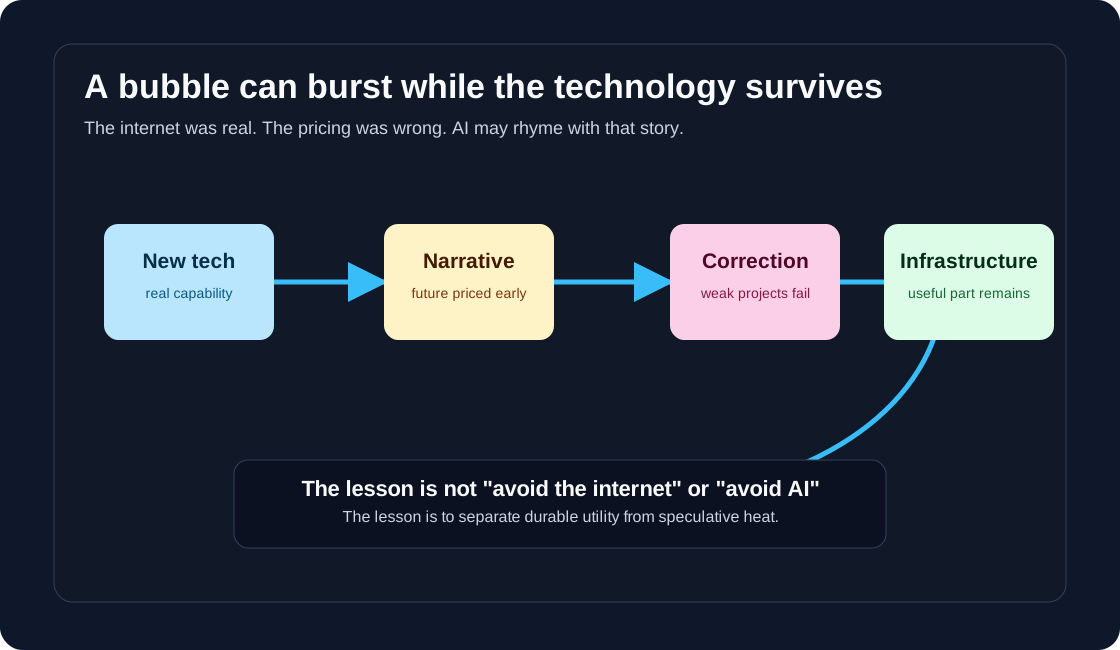
People sometimes talk about it as if the internet was a bad idea. It was not. The internet was one of the most important technologies in modern life.
The problem was that the market priced the future too early. Too many companies had weak business models, too much easy capital, too much “add .com and it will work” thinking, and not enough real revenue.
Then the correction came.
The Nasdaq Composite peaked in March 2000 and fell around 78% by October 2002. Many companies disappeared. But the internet did not disappear. The survivors and later builders became the foundation of the next two decades.
That is the lesson for me:
A bubble can be real even when the technology is real.
Why AI feels similar
AI has some very familiar signals:
- huge capital investment
- big promises
- startups using AI as a label, not a product
- expensive infrastructure buildout
- pressure to “do AI” before knowing the problem
- demos that look amazing but break in production
- unclear ROI in many companies
Gartner predicted that more than 40% of agentic AI projects will be canceled by the end of 2027 because of cost, unclear business value, or weak risk controls.
McKinsey’s 2025 survey also shows the gap clearly: many organizations are using AI, but turning pilots into scaled business impact is still hard. Only some organizations report measurable EBIT impact, and often that impact is still small.
So yes, there is hype.
Some of it will fail.
Some companies will spend too much money.
Some people will learn the hard way that a beautiful demo is not the same as an operating business.
Why AI is also different
At the same time, I do not think “AI is just a bubble” is a serious answer.
The Stanford AI Index 2026 reports very high organizational adoption and very large private investment. It also reports fast consumer adoption and measurable productivity gains in areas such as customer support, software development, and marketing output.
More importantly, AI is already useful in daily work:
- writing first drafts
- summarizing documents
- searching codebases
- explaining code
- generating tests
- helping customer support
- translating and editing
- making analysis faster
- helping people learn
That does not mean every AI company is valuable. It means the underlying capability is real.
This is where the dot-com comparison helps again. The internet was real. Many internet companies were not.
AI may be the same.
The question I use
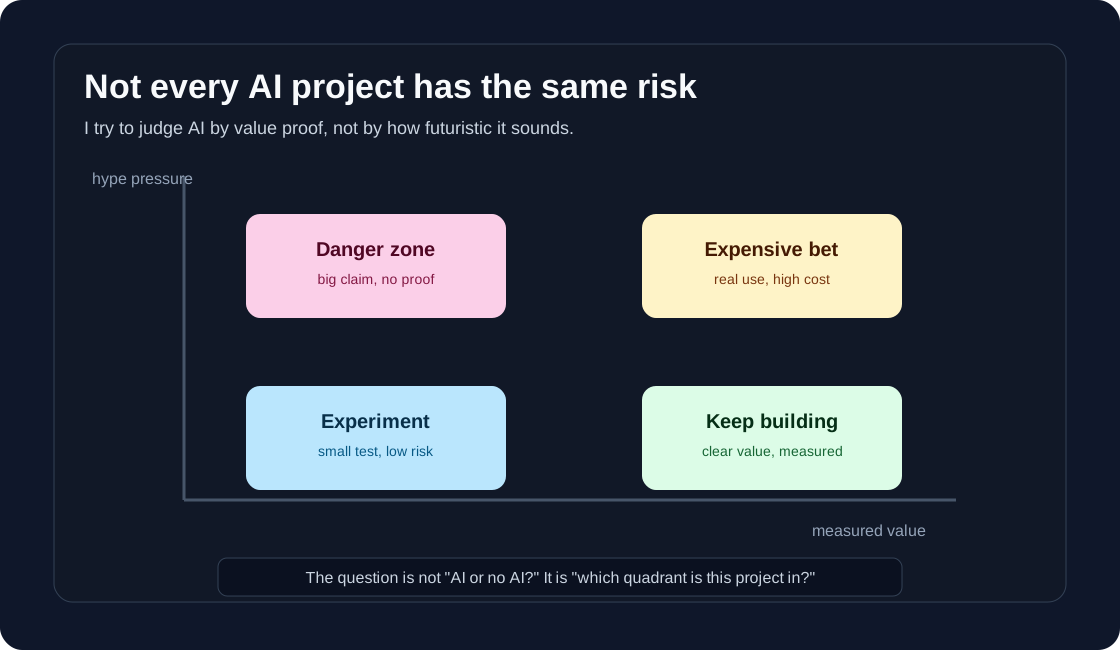
When I see an AI project, I try to ask:
Is this solving a painful workflow,
or is it just attaching AI to a pitch deck?
That one question removes a lot of confusion.
Bubble project signals
I get nervous when I see these signs:
- The product starts with “AI-powered” before explaining the problem.
- There is no measurable success metric.
- The demo works only on perfect examples.
- The cost per task is ignored.
- Data privacy is treated as an afterthought.
- The team cannot explain what happens when the model is wrong.
- Users do not return after the first exciting demo.
- The plan is “replace people” instead of “improve a workflow.”
These are not signs that AI is bad.
They are signs that the project is weak.
Healthy AI project signals
I feel much better when I see:
- a clear user pain
- a baseline measurement before AI
- a small pilot
- human review where mistakes are expensive
- clear data boundaries
- monitoring and rollback
- cost tracking
- boring but useful workflow integration
The word “boring” is important.
The best AI use cases may not look like science fiction. They may look like saving two hours a week, reducing support backlog, finding bugs faster, or making internal knowledge searchable.
That is not glamorous. It is useful.
Should we avoid AI?
No.
Avoiding AI because there may be a bubble feels like avoiding the internet in 2001 because many dot-com companies failed.
That would have been the wrong lesson.
The right lesson is:
Do not confuse the market cycle with the technology cycle.
Markets can overreact. Companies can overbuild. Valuations can become silly. But the useful parts of a technology can keep improving underneath the noise.
So I do not want to avoid AI.
I want to avoid becoming dependent on hype.
How I would live with it
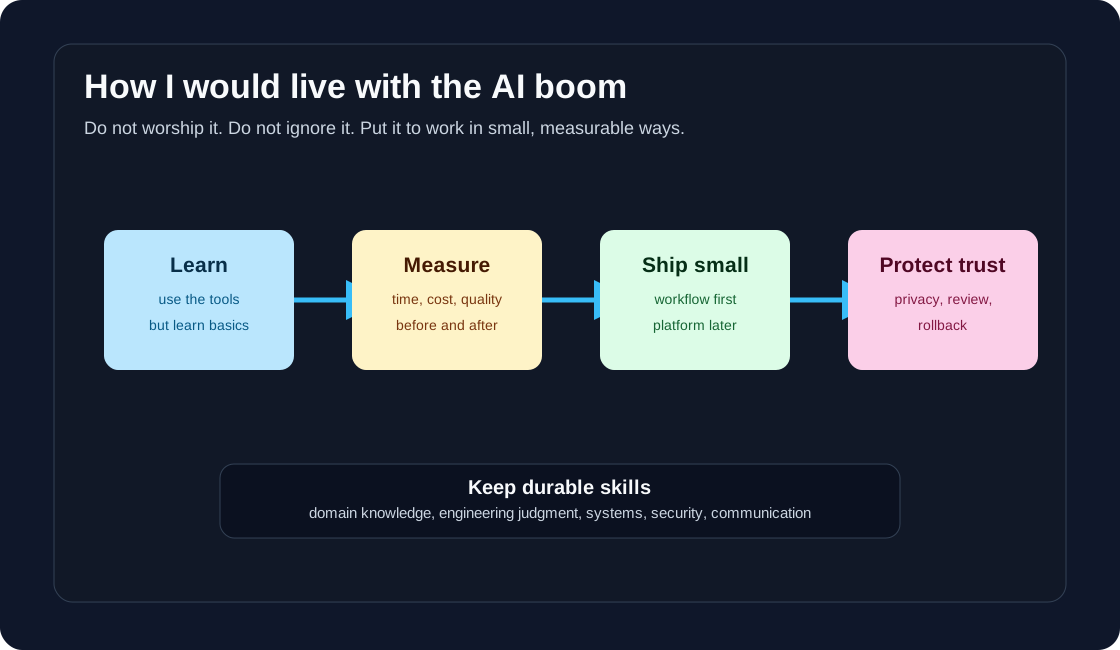
My practical rule is:
Use AI deeply.
Trust it slowly.
Measure it honestly.
1. Learn the tools
I would learn how to use AI for real work:
- coding assistance
- writing tests
- summarizing long documents
- exploring unfamiliar code
- drafting internal docs
- creating first-pass analysis
Not because AI is magic. Because it is becoming part of the toolchain.
2. Keep the fundamentals
AI makes fundamentals more important, not less.
If I cannot judge the output, I am not using AI. AI is using me.
For software engineers, that means I still need:
- data structures and algorithms
- system design
- testing
- debugging
- security basics
- product thinking
- communication
The tool can help me move faster. It cannot own my judgment.
3. Run small experiments
For any AI idea, I would avoid big-bang adoption.
Start with one workflow:
Before AI: how long does this take?
With AI: how long does it take?
What errors appear?
What does review cost?
Would users actually keep using it?
Run it for two weeks. Measure. Then decide.
This is less exciting than a grand AI transformation strategy. It is also less likely to waste money.
4. Watch the cost
AI is not free.
There is model cost, infrastructure cost, latency cost, review cost, security cost, and maintenance cost.
If the AI saves one hour but creates three hours of review, it is not productivity. It is theater.
5. Protect trust
AI can make mistakes very confidently.
So any serious AI workflow needs:
- human review for high-risk decisions
- logging
- rollback
- privacy boundaries
- clear ownership
- tests or evaluations
- a way to say “I do not know”
Trust is not created by saying “AI-powered.” Trust is created by predictable behavior.
Examples I would actually try
As a software engineer, I would start with practical internal tools:
Code review assistant
Use AI to check for missing tests, risky diffs, duplicated logic, and unclear naming.
Do not let it approve code. Let it raise questions.
Documentation search
Connect AI to internal docs so engineers can find architecture decisions, runbooks, and onboarding notes faster.
Measure whether people find answers faster.
Support triage
Use AI to summarize tickets, detect duplicates, and suggest categories.
Keep a human in the loop for customer-facing replies.
Test generation helper
Use AI to propose edge cases.
The engineer still decides which tests are meaningful.
These are not revolutionary. That is why I like them.
My conclusion
AI may contain a bubble.
It may even contain several bubbles: startup valuations, infrastructure spending, agentic AI projects, and enterprise transformation promises.
But I do not think AI itself is fake.
The practical move is to live in the middle:
Do not worship AI.
Do not ignore AI.
Use it where it makes a workflow better.
Measure the result.
Keep your judgment.
If the bubble pops, useful AI will still remain.
Just like useful internet remained after dot-com.
Sources
- Stanford HAI: 2026 AI Index Report
- Stanford HAI: 2026 AI Index Economy chapter
- McKinsey: The state of AI in 2025
- Gartner: Over 40% of agentic AI projects will be canceled by end of 2027
- Fidelity: Is AI a bubble? 5 signs to watch for
- Bank of England Financial Stability Report, December 2025
- Dot-com bubble overview