Do Agent Skills Actually Help? I Tried Writing One
I keep seeing skills recommended as a way to make coding agents better. My first question was simple: if a skill is mostly a Markdown file, how much difference can it make?
After reading the specification and trying a small example, my answer is: skills can make useful procedures reusable, but installing one does not prove it improves the result. That second part matters more than the number of skills in the folder.
What a skill actually is
An Agent Skill is a folder containing a SKILL.md, optionally accompanied by scripts, reference documents, or templates. The Markdown starts with a name and description, followed by instructions. It supplies context at runtime; it does not retrain the model or change its weights. Agent Skills specification.
The host matters. A supporting agent normally sees the skill’s metadata first, reads the instructions when it activates the skill, and loads additional resources when needed. This is called progressive disclosure: every workflow does not have to be pasted into every conversation.
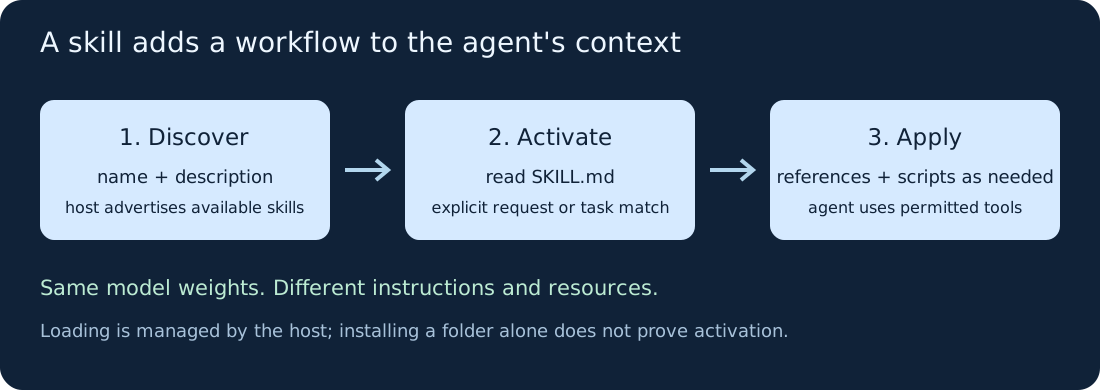
A useful distinction:
| Mechanism | What I use it for |
|---|---|
| A prompt | Instructions for this particular task |
Repository instructions, such as AGENTS.md in Codex |
Conventions that apply across work in that repository |
| A skill | A named workflow to select when the task needs it |
| A tool or MCP integration | An operation the agent can call, such as reading a database |
A skill can explain how to use a tool; it does not create that tool or grant access to it. The same instructions pasted directly into a prompt may help too. Packaging primarily changes discovery, reuse, and maintenance.
Is there evidence that skills help?
There is more than anecdote. SkillsBench v4 reports matched evaluations across 87 tasks and 18 model–harness configurations. Curated skills raised the aggregate average pass rate from 33.9% to 50.5%, an increase of 16.6 percentage points. The reported gains varied by configuration. Paper, version 4.
That is evidence for curated skills on those tasks, not a promise that any downloaded skill makes any agent better. The benchmark also bundles procedural knowledge with the skill condition; it does not establish that a SKILL.md file beats giving the agent equivalent information another way.
For my own workflow, I would compare correctness, time, token usage, and unnecessary actions on repeated representative tasks. A skill that produces a longer answer without reducing mistakes may be extra overhead.
Write one small skill
I chose a familiar task: reviewing a Jekyll post before publication. Two easy-to-miss problems are a future timestamp and a missing image. My skill is deliberately a source review, not a deployment tool.
The folder is:
.agents/skills/jekyll-publish-review/
└── SKILL.md
Here is the shape of the file; the downloadable demo contains the full version:
---
name: jekyll-publish-review
description: Use when reviewing a Jekyll Markdown post for publication readiness, especially scheduled dates and local image references.
---

# Jekyll publication review

1. Read the post frontmatter and _config.yml.
2. Compare the full timestamp, including its UTC offset,
   with the supplied current instant.
3. Check whether future: false excludes the post.
4. Resolve local Markdown image paths and check they exist.
5. Return: Verdict, Evidence, Not checked.

Do not edit or publish files during review.
The description gives the agent a reason to select it. The body gives a concrete procedure and an output contract. I would keep this narrow, move lengthy reference material into separate files, and use deterministic scripts for checks that need to be exact. Authoring guidance.
Install and try it
Unzip the demo, enter agent-skills-demo/fixture, and install the local skill:
mkdir -p .agents/skills/jekyll-publish-review
cp ../skill/SKILL.md .agents/skills/jekyll-publish-review/SKILL.md
In a Codex session opened from that folder, explicitly request it:
$jekyll-publish-review
Review this Jekyll post for publishing readiness.
The simulated current instant is 2026-11-12T08:30:00Z.
Report blockers with evidence. Do not edit, build, or use the network.
Codex documents repository-local discovery under .agents/skills, explicit invocation with $, and implicit selection by description. If a change does not appear, restart the session. Other hosts have their own installation and invocation details. Codex skills documentation.
What happened in my test
I used two fresh subagent contexts in the same managed Codex session, inheriting the same parent model. One reviewed the fixture without this task-specific skill; the other was explicitly told to read the installed skill first. The fixture, simulated clock, and review request were otherwise the same. Other runtime instructions stayed in place.
| Check | Without this skill | With this skill |
|---|---|---|
| Future timestamp: 17:00Z is after 08:30Z | Found | Found |
Missing /assets/release-flow.svg |
Found | Found |
| States that no build was run | Yes | Yes |
| Uses the skill’s three named sections | No | Yes |
The baseline also flagged the placeholder site URL. So I cannot claim the skill found more problems. It made the report follow a defined format; even the statement about untested behavior was already present in the baseline.
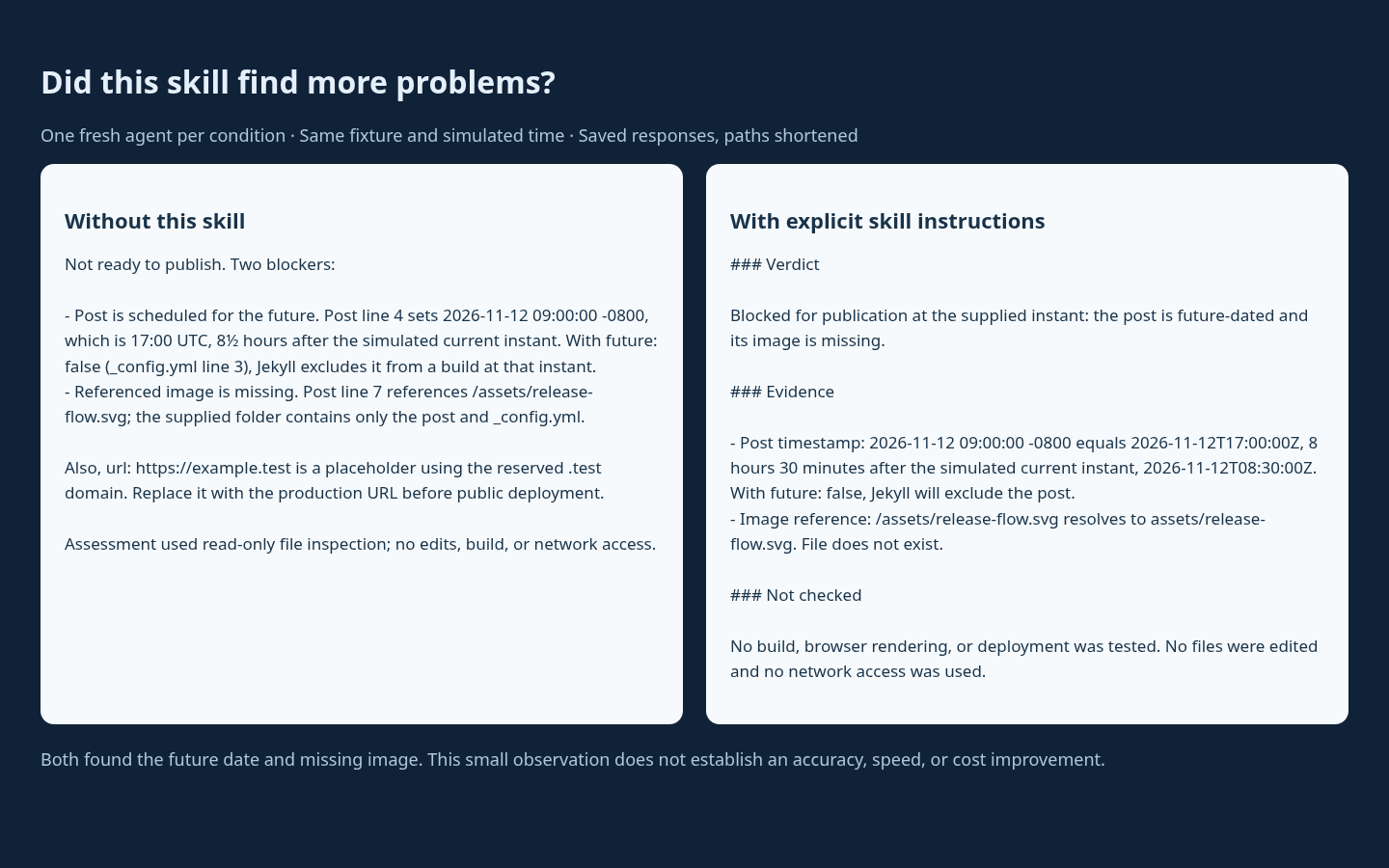
This is a screenshot of a report rendered from the saved responses, with paths shortened, not a screenshot of an agent application’s UI. The responses and fixture are included in the download.
This is one observation per condition, not a statistical benchmark. I tested applying explicitly loaded instructions, not automatic discovery, and did not measure speed or cost. The fixture has a deliberately fixed clock so the date check stays reproducible.
What I would keep
I would write a skill when I keep repeating a procedure that includes decisions, conventions, and useful references. I would test it on new cases, including tasks where it should stay inactive, before adding more instructions.
I would also read downloaded skills and their scripts before running them: they are instructions and potentially executable code, not just descriptions.
My small test did not show a correctness gain. The stronger reason to keep a skill here is to make a known review procedure easy to invoke and maintain. Whether that saves work over time is something I would measure, rather than assume from a successful demo.